The nickname dog nose came from the new look of the engineer cab, or nose, as compared to previous train sets. The benefit of this shape nose was the safety of the engineer for frontal collisions.
The railroad name of materiel '54 is based upon the year of development, the first units arrived in service in 1956.
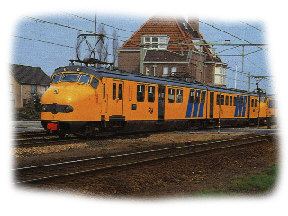
In 1957 a series of two car sets came in service for the international route between Amsterdam, the Netherlands and Brussels, Belgium.
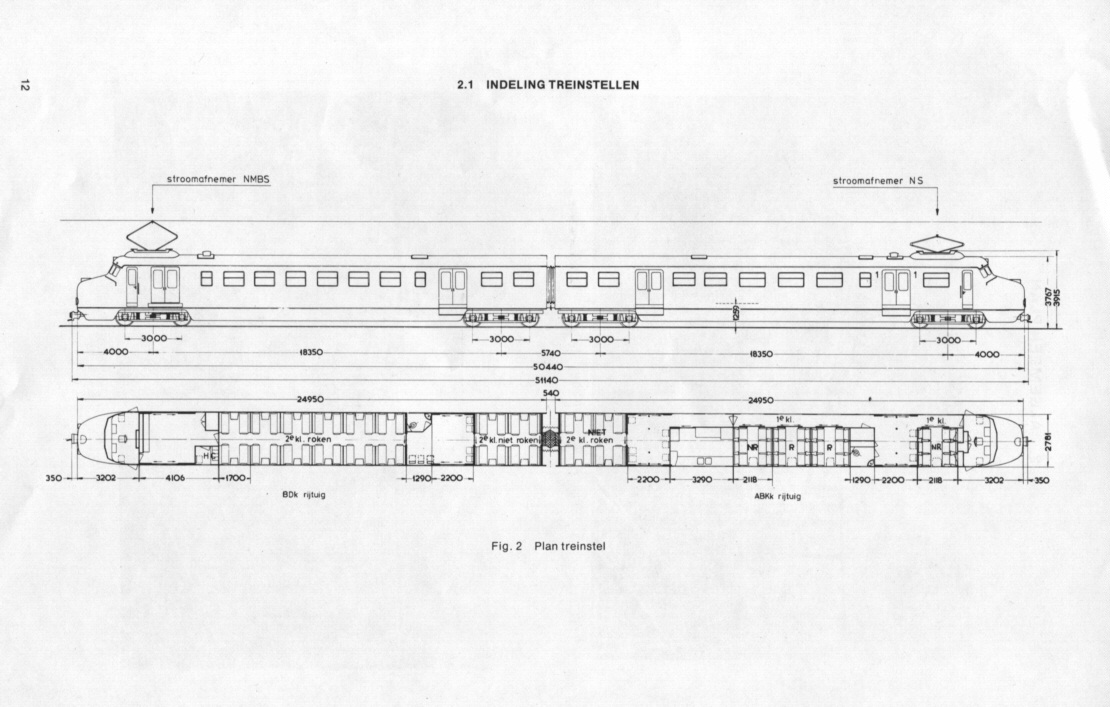
The biggest difference was the capability of operating on two different systems, Dutch 1500 Volt DC and Belgium 3000 Volt DC. In the Netherlands she was often coupled to her two and/or four car set sisters


A few units were changed especially for the intercity service, and were painted yellow with a bleu banner on the side. The seating became coach, instead of a face to face seating.
The series was numbered 1700, and some also got equipped with single spar pantographs.
drawings:
series 300, two car set
series 700, four car set
series 1200, Benelux train set
train set 1970
powered truck
un powered truck




And new the dog nose in model, kit bashed with a Lima model and Mastica kits.

I am building three two car set's and three four car set's, in the old green and new yellow colors, as well a Benelux version.
series 300 two car set green
series 300 two car set yellow
series 1200 two car set Benelux
series 700 four car set green
series 700 four car set yellow
series 1700 four car set IC


These Mastica kits are sidewalls with the proper spacing of windows and doors. The original Lima model is a four-car set made out of two identical cars, and is therefore not prototypical.
First we disassemble the Lima train, for the two car set, we only need the two head end units.
From the glass we only need the cab windows.
The main body will be mostly kit bashed, and the bottom part just a little modified.


For a Dutch two-car set we remove the two pantograph attachments from one head end car.
For a Benelux set we remove the inner attachment from each car.
Do this with all two or four cars, and then the other side from each car.
Mastica supplied a special holding fixture to maintain proper spacing of the walls.


